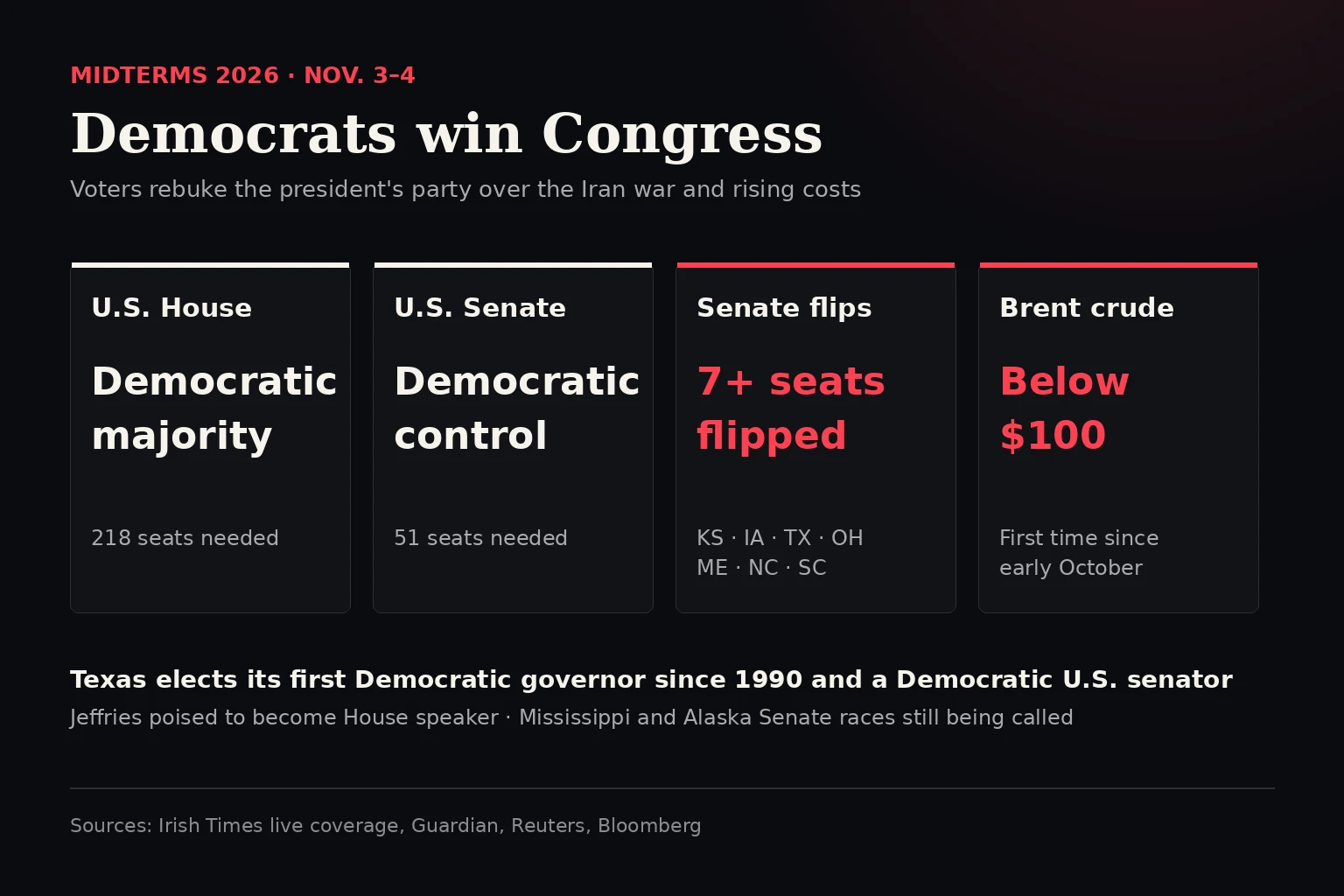




Democrats have won control of both the House and the Senate in the 2026 midterm elections, ending Republican control of Congress and handing the party subpoena power and a veto over President Donald Trump’s nominees. Trump and Vice President JD Vance both blamed the war in Iran for the losses, according to Irish Times live coverage of the results.
Democrats secure both chambers
The Guardian reported that Democrats had secured at least 228 House seats, against 218 needed for a majority, and 54 Senate seats, against 51 needed for control. By Wednesday evening the Irish Times put the House tally at 237 seats. Counts were still moving, and Senate races in Mississippi and Alaska had not been called.
Democrats flipped at least seven Senate seats in red states and battlegrounds, the Guardian said, including Kansas, Iowa, Texas, Ohio, Maine, North Carolina and South Carolina. Kansas had not elected a Democratic senator in nearly a century. In the House, the party flipped more than two dozen districts.
Texas turns blue
Texas delivered some of the night’s biggest upsets. Democrat James Talarico won the state’s Senate seat, ending a 38-year drought for his party, and Gina Hinojosa defeated Gov. Greg Abbott to become the state’s first Latina governor. Democrats also took control of the Texas House for the first time since the 2002 election, the Guardian reported.
Elsewhere, Abdul El-Sayed won in Michigan to become the first Muslim U.S. senator, Keisha Lance Bottoms was elected Georgia’s first Black governor, and Deb Haaland won in New Mexico.
Trump and Vance blame the Iran war
Vance wrote on X that the main reason Republicans lost was the war, saying many 2024 Trump voters backed Democrats this year. Trump told reporters the Iran war was “largely” to blame because it pushed gasoline prices up, but said he would do it again, adding that Iran cannot be allowed to have a nuclear weapon.
Trump also said Republicans would have won had he been on the ballot. Florida Gov. Ron DeSantis called the losses close to an “extinction level event” for Republicans, noting that of the ten largest states only Florida would remain under Republican control.
Leadership changes in the House
House Democratic leader Hakeem Jeffries announced a bid for speaker and would be the first Black speaker in U.S. history if elected when the new Congress is sworn in in January. Bloomberg reported that outgoing Speaker Mike Johnson does not plan to lead House Republicans next year, setting up a contest among Republican leaders such as Steve Scalise and Jim Jordan.
What a Democratic Congress can do
With both chambers, Democrats gain the power to investigate the administration and to block judicial and executive nominees, though Trump keeps the veto. Rep. Ted Lieu said Democrats would hold public hearings on artificial intelligence and pass what he called reasonable guardrails, including around new data centers.
Markets and the world react
Wall Street rallied on Wednesday on expectations that a divided Washington could limit sharp policy shifts, with the Dow up more than 2% in early trading, Reuters reported. Data-center and defense stocks fell on worries about tighter AI oversight and defense budgets. Bloomberg said Brent crude dropped below $100 a barrel for the first time since early October.
Ukrainian President Volodymyr Zelenskiy said he hoped the new Congress would bring more support for Kyiv, while Iran’s parliament speaker said Americans had voted against war.
What to watch: final calls in Mississippi and Alaska, the House speaker vote in January, and whether Trump changes course on Iran and tariffs now that he faces a Democratic Congress.
Sources: The Irish Times live coverage, The Guardian, Reuters, Bloomberg.