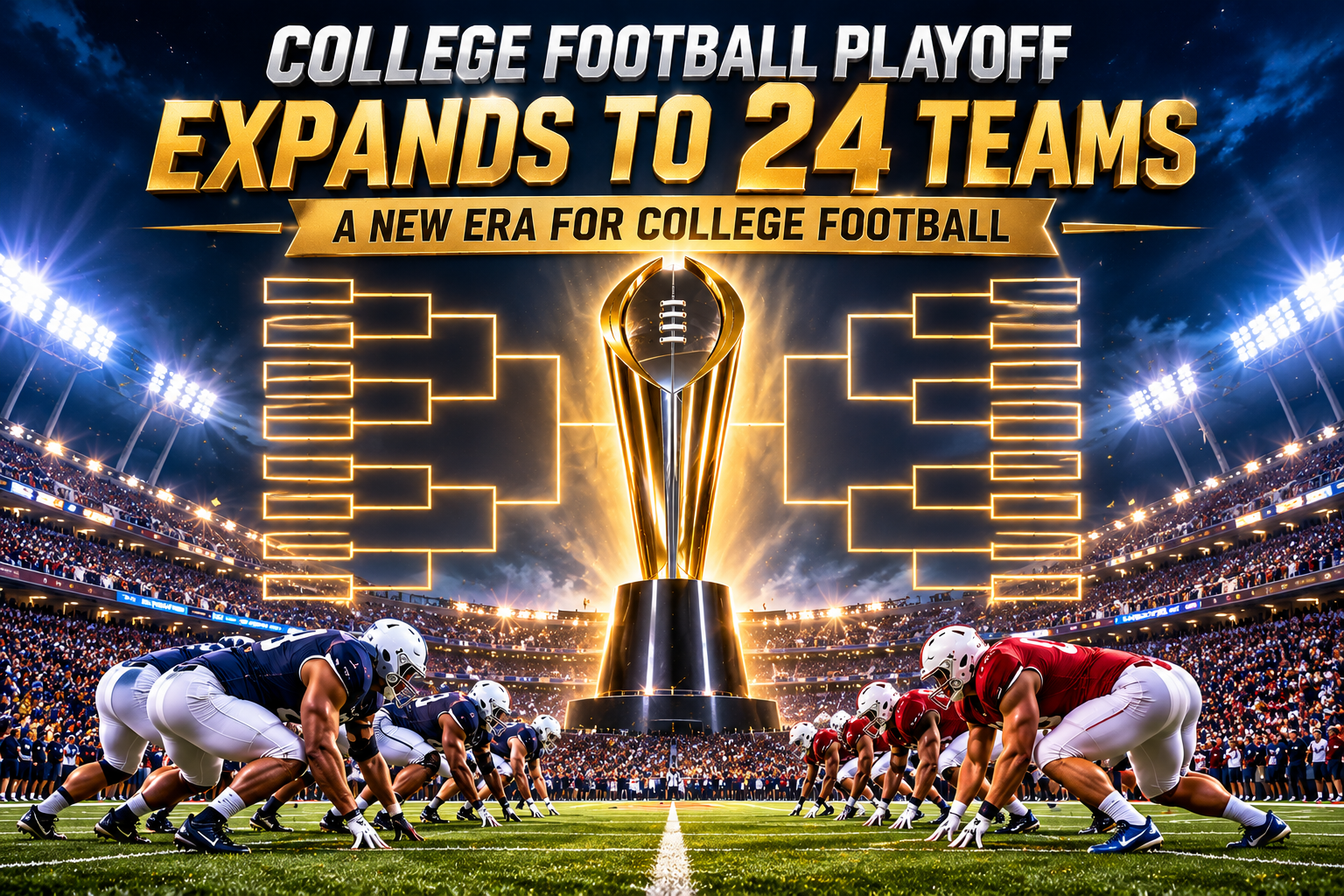




New York — College football is preparing for one of the biggest changes in its modern history. The College Football Playoff Management Committee has unanimously approved an expansion from 12 to 24 teams beginning with the 2027-28 season, creating a significantly larger postseason competition and giving more programs an opportunity to compete for the national championship.
The decision, announced November 9, 2026, also includes a new media rights agreement with ESPN, which will remain the exclusive worldwide broadcaster of the expanded playoff through the 2031-32 season, subject to sublicensing provisions.
According to The Associated Press, the agreement includes an additional $1.7 billion in ESPN payments over five years, on top of its existing media rights contract. The financial arrangement is expected to help offset revenue changes associated with the expanded postseason.
How the 24-team playoff will work
The expanded field will consist of 24 teams. Four automatic places will go to the champions of the ACC, Big Ten, Big 12 and SEC. Another automatic place will be awarded to the highest-ranked champion from the Group of Six conferences: the American, Conference USA, MAC, Mountain West, Pac-12 or Sun Belt.
The remaining 19 positions will be awarded to the highest-ranked eligible teams selected by the College Football Playoff selection committee.
The top eight teams in the final rankings will receive first-round byes. Teams ranked from ninth through 16th will host first-round games against teams ranked from 17th through 24th. Winners will advance to the second round, where the top eight seeds will host games on their home campuses.
The new competition will feature 23 games, with 16 games played on college campuses. The quarterfinals and semifinals will continue to be hosted at the six traditional College Football Playoff bowl locations.
ESPN secures expanded broadcasting rights
ESPN and the College Football Playoff have reached a new media rights agreement covering the expanded tournament. ESPN will have worldwide exclusive rights to the 24-team competition, with the ability to sublicense selected games.
The agreement covers all 23 games, including the first and second rounds, quarterfinals, semifinals and national championship. ABC will also broadcast at least three games from each of the newly expanded first and second rounds.
According to ESPN, the new arrangement runs through the 2031-32 season and builds on its existing relationship with the College Football Playoff.
Conference championship games face a major challenge
The expanded postseason could reshape the traditional conference championship weekend, which has long been one of the most important events on the college football calendar.
The Associated Press reports that the move will bring an end to the Power Four conference championship showdowns under the new arrangement. However, the official College Football Playoff announcement states that decisions about the future of individual conference championship games remain with the conferences themselves.
The new calendar also protects the traditional Army-Navy game from scheduling conflicts with playoff games. The College Football Playoff will begin its expanded postseason in December, with two open weeks built into the regular season.
Notre Dame and the Group of Six face a new landscape
The new qualification structure also changes the position of independent programs such as Notre Dame. Unlike the existing 12-team arrangement, the expanded format does not provide Notre Dame with a guaranteed place based solely on finishing within a particular ranking threshold. The university will compete for one of the 19 at-large positions.
For Group of Six programs, the highest-ranked conference champion will receive an automatic berth. This preserves a direct pathway for teams outside the Power Four conferences to reach the national championship tournament.
The new scheduling standards also require Power Four programs to play at least 10 qualifying regular-season games against conference opponents, other Power Four teams or Notre Dame. Group of Six programs will also be expected to play at least 10 qualifying games, primarily against conference opponents and specified eligible opponents.
Supporters welcome more opportunities, critics raise concerns
Supporters of expansion believe a 24-team tournament will keep more programs in contention later in the season, increase fan engagement and provide additional opportunities for teams that might previously have missed the postseason.
Critics, however, question whether a larger field could reduce the importance of regular-season games and traditional conference rivalries. There are also concerns about the increased influence of the selection committee, whose rankings and decisions will determine 19 of the 24 participants.
The expanded competition will bring college football closer to a professional-style playoff structure, but its long-term success will depend on whether fans embrace the new format.
When will the 24-team playoff begin?
The current 2026-27 College Football Playoff will continue with its existing 12-team format. The expanded 24-team competition will begin in the 2027-28 season.
The first national championship under the expanded format is scheduled for January 24, 2028, in New Orleans, Louisiana. Tampa Bay is scheduled to host the championship game in January 2029.
With more teams, more home-campus games and a new broadcasting agreement, college football is entering a major new chapter. The 2027 season will reveal whether the expanded playoff delivers the excitement and competitive balance its supporters promise.
Sources and further reporting
This report draws on coverage and official announcements from multiple sources:
- The Associated Press: College Football Playoff decides to double down and a 24-team playoff is set for next season.
- College Football Playoff: Official 24-team expansion announcement and format details.
- ESPN Press Room: Expanded playoff media rights agreement.
- College Football Playoff: Earlier update on expansion discussions.
Editorial note: Financial figures are attributed to AP reporting. The official CFP announcement did not disclose the financial terms of its ESPN agreement. Conference championship decisions remain with individual conferences.